The Generation Z March in the Zócalo: Mexican Youth Demand Security and Justice
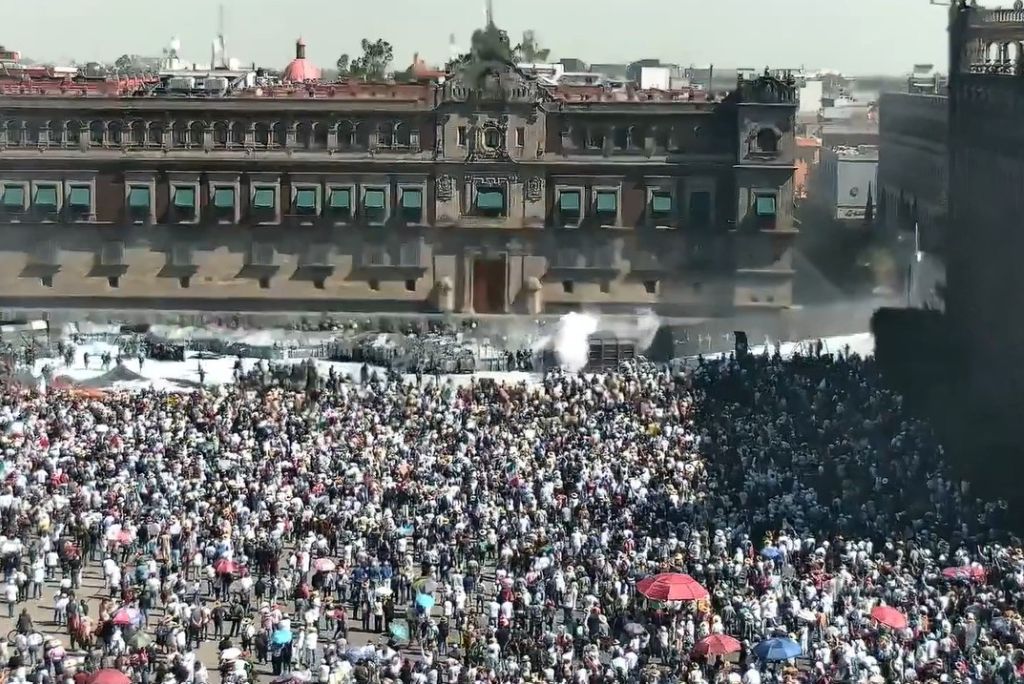
Thousands of young people and families took to the streets of the capital this Saturday to join the march called by the «Generación Z México» movement.
The mobilization, which started from the Angel of Independence toward the Zócalo in the capital, seeks to highlight discontent with insecurity, corruption, and violence plaguing the country.
Although the event was presented as peaceful and non-partisan, tensions in the Plaza de la Constitución marked the end of the day, with attempts to tear down protective barriers and responses from authorities.
Generation Z, born between 1997 and 2012, represents more than 37 million people in Mexico, a demographic group that has grown up amid escalating social and economic challenges.
This march is the second of its kind in November, driven by the assassination of Uruapan’s mayor, Michoacán, Carlos Manzo, on November 1. The movement adopted the flag from the anime «One Piece» as its symbol, a cultural nod to youth that emphasizes themes of freedom and resistance, and distanced itself from any acts of vandalism.
The call to action spread widely on social media, inviting participants to wear white and carry hats to identify with the movement. Organizers from the «Generación Z México» collective clarified that it is not a politically aligned protest with parties, but a citizen demand for «a safer, fairer Mexico free from corruption.»
However, opposition political figures and criticisms from the federal government, which attribute the organization to businessmen like Ricardo Salinas Pliego and Claudio X. González, have polarized the debate.
Development of the March
The main contingent gathered around 10:00 a.m. at the Angel of Independence, beginning the advance at 11:00 a.m. along Paseo de la Reforma, Avenida Juárez, and Calle Madero, arriving at the Zócalo about three hours later. The route, one of the most traveled in capital demonstrations, affected traffic in the Historic Center, with road closures that the Ciudad de México’s Centro de Comando, Control, Cómputo, Comunicaciones y Contacto Ciudadano (C5) recommended avoiding.
The march proceeded mostly peacefully, with signs shouting «Out with Morena!», «Recall of mandate!» and «Justice for Carlos Manzo.» Groups such as mothers searching for the disappeared, families, and even musical bands that animated the route joined in. In the Zócalo, the reading of demands was scheduled for 1:00 p.m., focused on access to medicines, an end to abusive taxes, and a halt to drug trafficking’s influence in politics.
Simultaneously, similar protests were reported in more than 30 cities and states, including Guadalajara, Monterrey, Puebla, and Tijuana, as well as in countries with Mexican diaspora like the United States and Spain. In Coahuila and Colima, for example, gatherings began in public squares starting at 4:00 p.m.
Incidents and Authorities’ Response
Upon arriving at the Zócalo, the scene shifted. Federal and local authorities had installed metal barriers up to three meters high around the National Palace and historical monuments as a preventive measure against possible disturbances.
A minority group, identified as the «black bloc»—hooded young people dressed in black—attempted to tear down these protections with tools like hammers and grinders, generating outbreaks of violence.
Elements of the Secretaría de Seguridad Ciudadana (SSC) responded with fire extinguishers to disperse the protesters, while reports emerged of detonations of devices and the launch of chemical powder.
Some peaceful participants criticized these acts, arguing that they delegitimized the march, and others reported minor injuries among police and civilians.
No mass arrests or major damage to infrastructure were recorded, but the incident caused partial evacuations and intermittent social media outages in the area.
Mexico City Government Head Clara Brugada justified the barriers as a «measure to protect historical heritage,» while the C5 deployed a special operation with more than 5,000 personnel. The Mexico City Metro kept the Zócalo/Tenochtitlán station closed until further notice.
This demonstration highlights the growing youth activism in Mexico, in a year marked by elections and political tensions. For many, it represents a «seed of social revolution,» as one banner in honor of Manzo stated. A young participant, interviewed by local media, emphasized: «We don’t cover our faces because we have nothing to fear; we march for our future.»
Government critics see the march as an echo of genuine discontent, while Morena supporters label it as an operation funded by conservative interests.
The truth is that, despite the divisions, the mobilization underscores the urgency of dialoguing about security and governance in a country where violence claims thousands of victims annually.
The day concluded with the gradual dispersal of protesters, leaving a partially empty Zócalo but with a clear message: Mexican youth demands change. It remains to be seen whether these demands will drive reforms or dissolve into political polarization.
About The Author