Court of Appeals Overturns Release of Pro-Hamas Activist Mahmoud Khalil and Backs President Donald Trump’s Administration
The U.S. federal judiciary corrected this week a decision that had sparked significant political and legal controversy.
The U.S. Court of Appeals for the Third Circuit overturned a ruling by a district judge who had ordered the release of pro-Hamas activist Mahmoud Khalil, a decision that strengthens the position of President Donald Trump’s administration on national security, immigration, and respect for the rule of law.
The ruling, issued on January 15, establishes that the lower court judge acted outside his jurisdiction by ordering Khalil’s release. Khalil, a lawful permanent resident, was detained by immigration authorities after participating in radical protests at U.S. universities.
The appeals court determined that immigration courts are the proper bodies to hear such cases, not a federal district court, as the judge who issued the initial order had claimed.
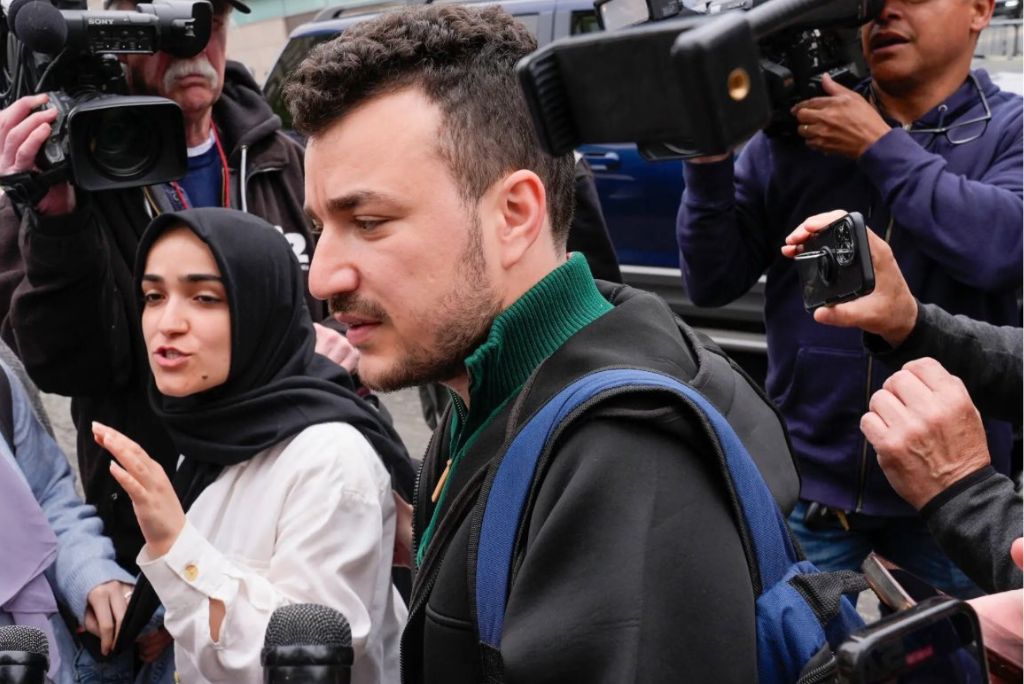
Mahmoud Khalil was arrested in March following a series of demonstrations linked to the conflict in the Middle East, during which he defended positions aligned with Hamas, an organization designated as terrorist by the United States.
Although no criminal charges were filed against him, the Trump administration maintained from the outset that his public activity and ideological profile posed a risk to U.S. foreign policy interests and national security—arguments supported by existing immigration law.
WATCH:
The district judge’s decision ordering Khalil’s release was initially celebrated by progressive organizations and left-wing activists, who portrayed the case as an example of “political repression.” However, the Court of Appeals dismantled that narrative by focusing on a key issue: the law.
According to the ruling, the judge lacked legal authority to intervene in a process that falls exclusively within immigration jurisdiction, rendering his decision legally invalid.
The State Department reacted swiftly to the decision, calling it a significant victory for President Donald Trump’s administration and reiterating that the United States will not allow sympathizers of terrorist organizations to exploit legal loopholes or judicial activism to evade the system’s safeguards.
Although the ruling does not mean Khalil’s automatic detention, it does open the door for authorities to resume proceedings within the correct legal framework.
The activist still has legal options, such as requesting a review of the ruling or appealing to higher courts, but the judicial blow is decisive and seriously weakens the strategy of those seeking to turn his case into a political symbol against the Trump administration.
WATCH:
This episode once again brings to the forefront a recurring problem in the United States: the role of activist judges who, under the banner of an expansive view of rights, intervene in areas where the law is clear and competencies are well defined.
This is not about freedom of speech, but about the limits of judicial power and the political use of the courts to block legitimate executive decisions.
The left needs these conflicts to sustain its narrative. It needs judges willing to reinterpret the law, universities turned into ideological platforms, and cases like Khalil’s to fuel confusion between rights and privileges.
Against that backdrop, decisions like that of the Third Circuit serve as a reminder that order, law, and institutional responsibility remain essential pillars of a nation that cannot afford to normalize radicalism or chaos as a form of governance.
READ MORE:
Stay informed with the most important news and reliable analysis!
Subscribe to the newsletter: https://gatewayhispanic.com/sl-newsletter
About The Author