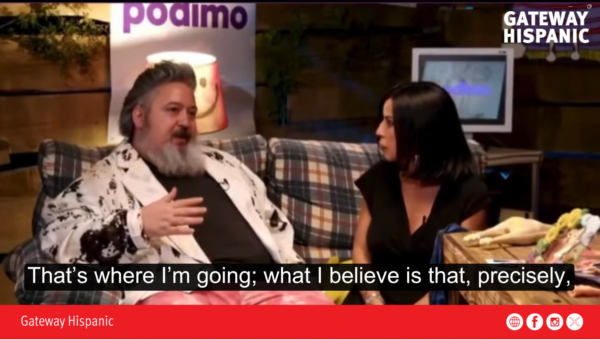
During an interview on the Sánchez Grass in America program, attorney and political analyst María Herrera Mellado offered her perspective on the most recent statements made by the President of the United States, who had criticized both Ukraine and several European countries for their stance on the war with Russia.
The host opened the conversation by noting that the president had made two main points: on one hand, he accused Ukrainians of being insufficiently grateful for the enormous support provided by the United States; and on the other, he stated that Europe continued acting hypocritically by proposing aid plans for Kyiv while maintaining energy ties with Moscow.
In Mellado’s analysis, she recalled that although, in the early stages of the war, several European countries still depended heavily on Russian oil and gas, in recent years that dependency has been significantly reduced. The attorney emphasized that this criticism of energy risk was nothing new: Donald Trump had already raised the issue during his previous administration, when he warned nations like Germany about the dangers of relying on Russian gas for their security.
Regarding the claim that Ukrainians were “ungrateful,” Mellado noted that it was essential to distinguish between the actions of a government and the views of a people. She explained that the Ukrainian population—including refugees who had arrived in the United States—clearly recognized the decisive role the U.S. had played since the beginning of the invasion. She also pointed out that President Volodymyr Zelensky himself had recently shown greater willingness to negotiate, precisely because Ukraine’s survival in the face of Russia’s advance has depended heavily on Washington’s military and financial support.
Mellado concluded that without U.S. assistance, the war would have taken a completely different course and Russian forces would have achieved rapid and devastating advances over Ukraine’s strategic and territorial structures.
A View Aligned with the Republican Perspective
In closing, Mellado reinforced a central idea fully aligned with the Republican viewpoint: that the president did not issue these warnings on a whim, but because he had recognized the risks that Europe preferred to ignore for years. According to the analyst, time proved him right. Today, even the most skeptical European governments acknowledge that Trump was correct in warning about Europe’s energy dependence on Moscow and the strategic consequences it entailed.
Mellado also emphasized that the president’s firmness toward Ukraine should not be interpreted as a lack of support, but as a call for responsibility. As she explained, the United States cannot continue carrying indefinitely the weight of a war that Europe was slow to assume—and which, without American leadership, would have been defined by Russia within the first weeks.
For Mellado, the president’s remarks once again reflect his direct style, his ability to anticipate crises, and his commitment to protecting U.S. interests above external pressures. And from that perspective, she stated that the country needs precisely that kind of leadership to confront an increasingly volatile international landscape.