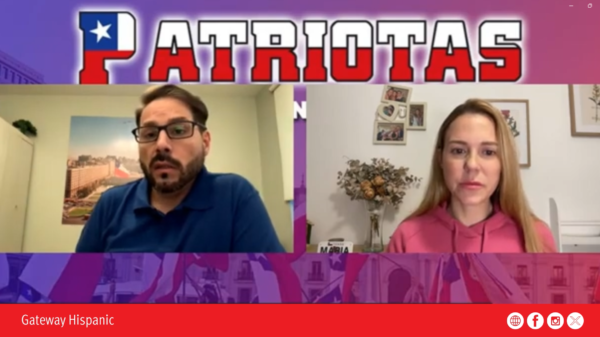
In a new edition of Sánchez Grass en América, political analyst and attorney María Herrera Mellado delved into the latest diplomatic moves led by the President of the United States, who has chosen to activate a parallel negotiation channel in an attempt to end the war between Russia and Ukraine. The central focus of the conversation revolved around the deployment of special envoy Steve Witkoff to Moscow—a direct decision by the President that, according to Mellado, represents a strategic shift from earlier efforts that stalled due to a lack of substantive progress.
During the discussion, Mellado emphasized that when it comes to Vladimir Putin, there is never full clarity between what he says publicly and what actually takes place on the ground. She noted that despite Moscow’s language of dialogue, Russia continues to attack Ukrainian positions relentlessly, just as President Volodymyr Zelensky has reported. According to Mellado, this contrast confirms that the conflict remains at a critical point and that any negotiation must account for the fact that both sides are trying to buy time in a game where nothing less than Ukraine’s territorial sovereignty, its potential —or renunciation of— NATO membership, and the real limits of Russian expansion in the region are at stake.
The analyst underscored that, given this scenario, the President has chosen not to exhaust himself with repeated direct meetings that yield no results. Instead, he is replicating a strategy he previously used successfully in other international conflicts, such as the one between Israel and Gaza: delegating the task to his most trusted envoys to explore possible agreements and ensure discreet yet effective discussions. “Before, it was Jared Kushner,” Mellado recalled, “and now it is Steve Witkoff who is leading this new effort.”
A High-Impact Peace Agreement
The confirmation that the U.S. special envoy will meet with Putin in Moscow has sparked expectations about the real possibility of achieving an agreement in record time. Mellado highlighted that, if accomplished, it would constitute a diplomatic achievement of enormous magnitude, comparable only to the last major peace accord brokered by the same President in the Middle East.
The President himself shared a forceful message on Truth Social: “With the hope of finalizing this peace plan, I have ordered my special envoy, Steve Witkoff, to meet with President Putin in Moscow.”
He also expressed his intention to meet both Putin and Zelensky, but only once the agreement is nearly finalized, in order to prevent negotiations from turning into a political spectacle and to preserve the efficiency that characterizes his mediation style.
Europe Watches, Washington Leads
During the interview, Mellado noted that although some European leaders have attempted to present diplomatic progress, the reality is that much of the burden still rests on the United States—particularly because Ukraine has made it clear that “much depends on Washington.” According to Mellado, this acknowledgment validates what the President has argued for months: without American leadership, Europe has been unable to stop Russia’s advances or establish a unified strategic direction.
The Republican Perspective: Strength and Results
In her conclusion, Mellado stressed that this new diplomatic initiative once again reaffirms the Republican view of the conflict: a strategy grounded in firmness, clarity, and the protection of U.S. interests, without overlooking global stability. According to the analyst, the President has demonstrated that he prioritizes tangible outcomes over prolonged diplomatic rhetoric.
This strategic move—the deployment of a high-level emissary to Moscow—not only reflects active leadership but also a genuine commitment to reaching a solution that would end a conflict that has weakened Europe’s economy, drained U.S. resources, and cost thousands of lives in Ukraine.
Mellado cautioned, however, that the most sensitive points of the agreement remain unresolved: Ukraine’s renunciation of NATO membership, the final territorial delineation, and the guarantees Russia must provide to prevent further military expansion. Without resolving these issues, Moscow may once again attempt to delay the process.
But for the first time in months, Mellado said, there are clear signs that both sides are willing to listen—and that opportunity, she emphasized, has emerged precisely because of the pressure and leadership of the U.S. President.