Spain falls behind the PIGS and major economies as its debt barely declines
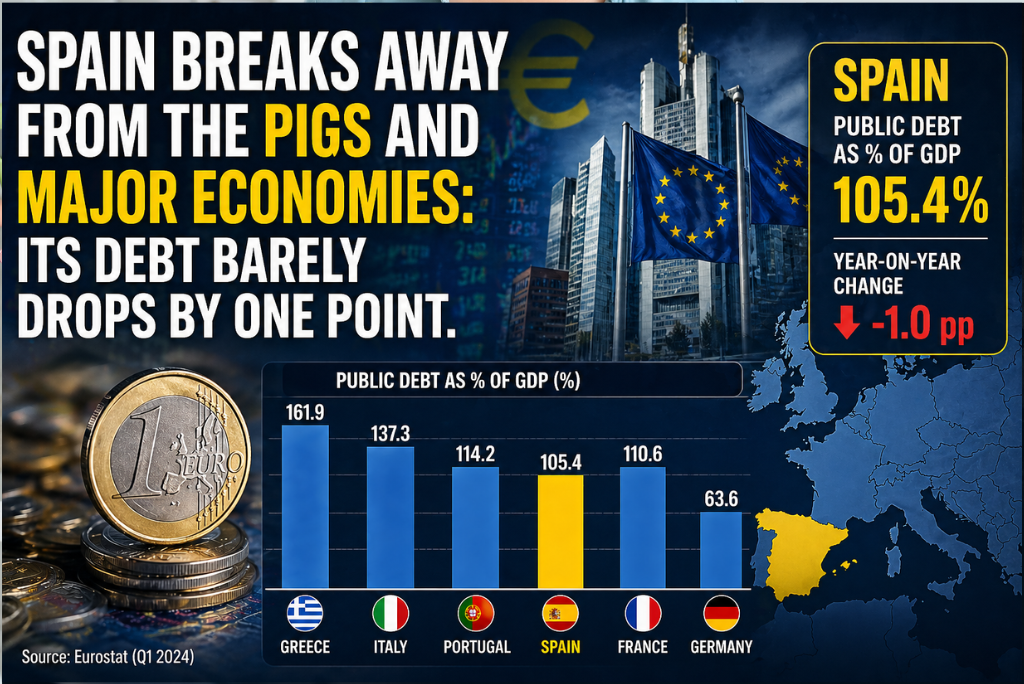
Spain is once again lagging in the process of reducing public debt, not only compared to the group of countries historically known as the “PIGS,” but also when measured against other major economies. Over the past year, Spain’s debt-to-GDP ratio has declined by just one percentage point—a modest improvement when contrasted with the efforts of its peers.
Within the former bloc of the eurozone’s most vulnerable economies, progress has been far more significant. Greece has managed to reduce its debt by eight points, consolidating a path of fiscal discipline after years of adjustment. Ireland has cut 5.4 points thanks to a combination of economic growth and budgetary control, while Portugal has reduced its debt by 3.8 points, strengthening its financial position.
Spain’s difference is not only one of magnitude, but also of nature. The decline in Spain’s debt is mainly driven by GDP growth rather than by a structural effort toward fiscal consolidation. This means that in the absence of growth, the improvement could stall or even reverse.
Comparison with major economies and global powers
When broadening the perspective, Spain’s relative weakness becomes even more evident. In the United States, although debt levels are high, its financing capacity, the size of its economy, and the role of the dollar as the world’s reserve currency allow it to sustain larger deficits without comparable immediate pressure. In addition, the dynamism of the private and technology sectors acts as a key engine of growth.
In this context, figures like Elon Musk symbolize how innovation and private investment—through companies such as Tesla and SpaceX—help strengthen economic competitiveness and wealth generation, indirectly supporting fiscal sustainability.
Meanwhile, China presents a different model, with strong state control and high levels of debt, particularly at regional and corporate levels. However, its capacity for direct intervention and its structural growth provide it with tools to manage these imbalances in a more centralized way.
In the case of Russia, public debt levels are relatively low compared to Western economies, partly due to conservative fiscal policies and reliance on energy revenues. However, its economy is constrained by geopolitical factors and international sanctions, limiting its long-term development.
The role of the European Union
At the European level, the European Union continues to exert pressure to ensure the sustainability of public finances. Following the reactivation of fiscal rules, Brussels requires member states—especially those with high debt levels—to present credible plans for reducing deficits and debt.
Spain is under particular scrutiny due to its high level of debt and the limited intensity of its adjustment. The European Commission has stressed that economic growth must be accompanied by structural reforms and fiscal discipline.
A model under question
The international contrast highlights a fundamental issue: while other economies combine growth with reforms or benefit from structural advantages (such as the dollar in the U.S. or state control in China), Spain relies heavily on the economic cycle without progressing at the same pace in fiscal consolidation.
This raises concerns about its ability to face future economic crises or shifts in global financial conditions, such as rising interest rates or economic slowdowns.
In an increasingly competitive international environment, with stricter fiscal demands from the European Union, relying solely on economic growth may not be enough. The real challenge lies in turning that growth into a structural reduction in debt and achieving a sustainable improvement in public finances.
Read more:
About The Author