Claudia Sheinbaum’s Security Gamble: A Bold Fix or Just Empty Promises?

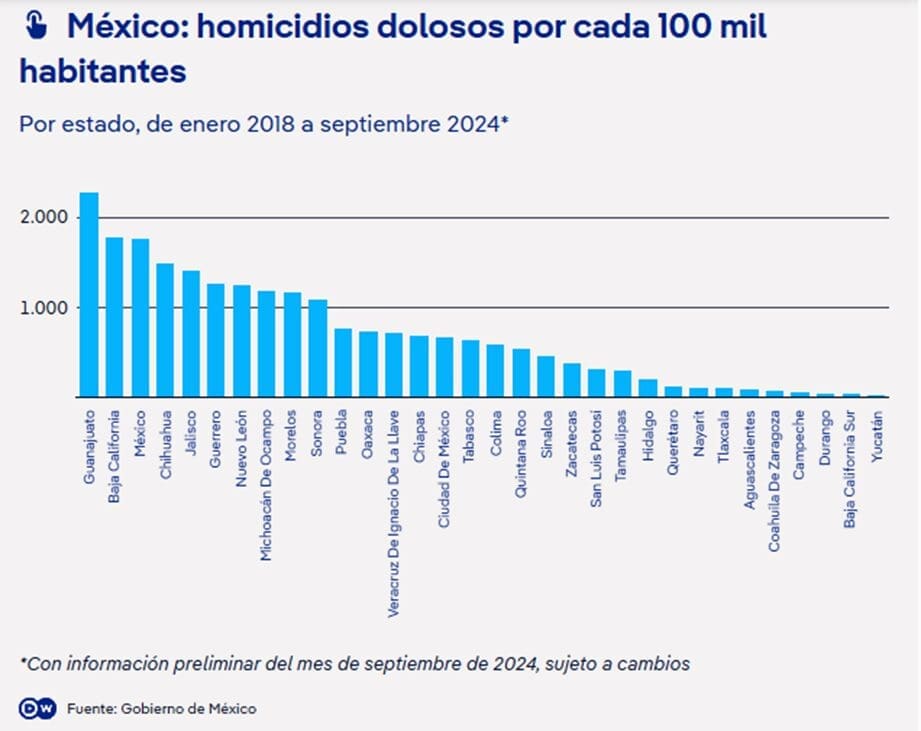
Claudia Sheinbaum’s unveiling of her security plan has stirred intense national debate, coming at a time when Mexico faces rampant violence and insecurity. As she steps into her new role, Sheinbaum is under immense pressure to show that her strategy can make a real difference in combating crime. But will this plan be the answer, or is it just a continuation of the failed policies of the past?
Her approach, which heavily emphasizes prevention and social justice, mirrors the rhetoric of her predecessor, Andrés Manuel López Obrador. Yet, many question whether this strategy, centered on social causes, can genuinely tackle the nation’s deep-rooted criminal issues.
A Soft Approach to a Hard Problem?
Sheinbaum’s plan, inspired by her “Barrio Adentro” initiative from her time as Mexico City mayor, focuses on integrating at-risk youth into education and employment to prevent their recruitment by organized crime. While this strategy showed some local success, it has raised concerns about its scalability nationwide, where criminal networks are far more entrenched and violent.
Sheinbaum’s argument is simple: addressing social inequalities will lower crime rates. “If the young person wasn’t attending high school, we would enroll them. If they lacked a university or a job, we would find them one,” she noted. But this idealistic vision ignores Mexico’s overwhelming institutional weaknesses—particularly the corruption that pervades law enforcement and the judicial system. Without tackling these systemic issues, prevention programs may fall flat.
Critics argue that even the best social policies cannot alone resolve a problem as complex as Mexico’s violence. Corruption within security forces and public prosecutors’ offices remains rampant, perpetuating a culture of impunity.
Militarizing Security: A Dangerous Path?
Perhaps the most contentious aspect of Sheinbaum’s plan is her defense of the National Guard—a force created under López Obrador’s administration that has increasingly blurred the line between civilian policing and military enforcement. While Sheinbaum insists that the National Guard is necessary to control regions where local police are outmatched by crime syndicates, human rights activists warn that giving military forces police powers is a risky gamble.
Recent incidents, such as the killing of six migrants by soldiers, have fueled fears that the militarization of public security is leading to more abuses and unchecked violence.
Sheinbaum’s security secretary, Omar García Harfuch, counters this narrative, arguing that the National Guard operates under a strict military doctrine designed to protect citizens. “It’s not militarization,” he claims, “we are simply leveraging the capabilities of the military to consolidate the National Guard.”
But critics remain unconvinced, pointing to the growing militarization under López Obrador and the continued escalation of violence despite these tactics. Is Sheinbaum simply repackaging an already failed approach?
Can Intelligence and Coordination Break the Cycle of Violence?
Beyond militarization, Sheinbaum’s plan highlights the need for better coordination and intelligence-sharing across Mexico’s fractured security institutions. Currently, the lack of collaboration between federal, state, and local authorities has allowed criminal organizations to exploit gaps in the system. Sheinbaum aims to close these gaps through advanced intelligence techniques and data analysis, hoping to outsmart the criminals rather than merely reacting to their violence.
However, replicating the success she achieved in Mexico City on a national scale poses significant challenges. The country’s criminal landscape is vastly more complex, with entire regions controlled by cartels that operate with near-impunity. Sheinbaum’s reliance on technology and intelligence may sound promising, but many doubt that Mexico’s weak institutions are up to the task.
Can Sheinbaum Deliver, or Is This Just More of the Same?
Sheinbaum’s security plan is ambitious, but it risks becoming just another chapter in Mexico’s long struggle with violence. While her focus on prevention, intelligence, and coordination is commendable, it remains to be seen whether she can address the deeper structural problems that have allowed criminal organizations to thrive.
Without confronting the corruption, impunity, and militarization that plague Mexico’s security forces, Sheinbaum may find herself trapped in the same cycle of failed strategies that have left the country in chaos. Only time will tell if her plan can break the mold or if it’s doomed to perpetuate the same ineffective policies of the past.
About The Author